 Change currency
 USD
USD
We now monitor our new and old designs across multiple popular websites and less known websites on a weekly basis, we use AI and individual 3rd party people to find anything that resembles our geometry (including mash-ups) on all 3d download sites and online sale platforms. All of our designs/models are copyrighted on protectmywork as well as the instant copyright protection they recieve the moment they are uploaded. All of our work is now uploaded to thangs who create a geometry fingerprint of the file.
It’s extremely easy for designers to take legal action if someone steals original 3D models. Copyright applies to digital designs the same way it applies to books, and the UK’s IPEC Small Claims Track lets creators pursue infringement without spending a fortune or hiring solicitors. STL theft is simple to prove because the geometry, mesh structure and unique design features make copying obvious.
You can’t sue someone for copying an idea - but you can sue them for copying the expression of that idea. Books, art, 3D models, characters, designs, sculptures, CAD geometry - all of those are expressions and expressions are protected by copyright the moment you create them. If anyone touches new original work, it’s a straightforward legal process to act.
If someone copies your geometry, proportions, sculpting, character design, mechanical layout, unique features, storyline or visual style or even the distinctive way your model works that’s copyright infringement - and yes, it’s just as easy to sue as it is with a book. Ideas aren’t protected, but execution is and ours is instantly recognisable. If anyone tries to rip off our future original work, it becomes one of the simplest copyright cases imaginable because STL theft is visually provable in seconds.
The 3D printing community is one of the most creative, passionate, and generous spaces online. People share their prints, help each other troubleshoot, celebrate successes, and proudly display the things they’ve made. It’s a community built on enthusiasm and curiosity - but there is a side of it that rarely gets talked about, a side that quietly hurts the very people who make this creativity possible and it’s time we talked about it.
Designing a 3D model isn’t “just clicking download.” It isn’t a quick export, a simple resize, or a few slicer tweaks. It is hours, days, sometimes weeks of work. Behind every model you print, there is a designer paying for electricity, filament, machine upkeep, failed prints, replacement parts, software, tools and - most of all - time. Then there’s the part nobody sees: the testing, the tolerances, the reprints, the redesigns, the mechanical failures, the geometry fixes, the trial and error, the frustration, the learning curve, the skill, the talent and the patience. Some designers do all of this while dealing with disabilities, limited vision, chronic pain, or other challenges that make the work even harder.
Designing isn’t “just a hobby.” It’s labour. It’s craft. It’s engineering. It’s art.
So why do so many people expect it for free?
A 3D printer can cost hundreds of pounds. Filament costs more every year. AMS units, upgrades and accessories cost even more. Yet many people balk at paying a few pounds for the file that makes the printer worth owning. It’s not that people can’t afford it - its the culture. Free model sites have created an expectation that everything should be free, even when the “free” model is stolen, miscredited, resized badly, or uploaded without permission which hurts designers more than most people realise.
One of the biggest misconceptions in the community is the idea that resizing, AMS colouring, or changing infill counts as a “remix.” It doesn’t. A remix requires new geometry, new design work, new creative decisions, new engineering and new structure. Resizing is not a remix. Changing infill is not a remix. AMS colouring is not a remix. These are slicer settings — not design. Calling them “custom work” or “my version” misleads the community and steals credit from the person who actually built the model from scratch.
Another harmful myth is the idea that “it’s from a game, so it’s not your design.” Game assets are copyrighted, but the 3D printable model is not the game asset. It is rebuilt, re‑engineered, redesigned, remodelled, re‑structured and recreated from scratch by a designer. The IP of the printable model belongs to the person who made it - not the game studio. Stealing a designer’s work because “it’s from Call of Duty” for an example is still theft.
Licensing exists for a reason. When a designer uploads a model under a Strict Non‑Commercial Licence, with requirements to credit the original creator, link the original file and avoid derivatives without permission, those rules are there to protect the designer’s income, reputation, brand and ability to keep creating. Ignoring those rules because “the designer won’t notice” or “they’re too busy to monitor it” is not harmless. It’s exploitation and it drives designers away from the community.
Free model sites are notoriously full of stolen work and downloading from them - even unknowingly - supports the problem. These platforms are saturated with stolen uploads. Stolen models often get more downloads than originals. Thieves get credit for work they didn’t do. Designers lose downloads, sales, visibility, motivation and eventually the desire to keep creating. Every download of a stolen model sends a message to the designer: “Your work isn’t worth paying for" and that message hurts more than people realise.
Supporting designers doesn’t always mean spending money. It can mean crediting the original creator, linking the original file, reporting stolen uploads, refusing to download or share stolen models, educating others, respecting licences, respecting the work and respecting the craft. When a designer charges a small fee for a model that took hours, days or weeks to create, that isn’t greed — it’s survival. Supporting them is how we keep this community alive.
Designers aren’t asking for much. They don’t expect every model to be paid. They don’t expect every hobbyist to spend money. They don’t expect everyone to understand the work behind the scenes but they do expect respect, honesty, credit, fairness, integrity and basic decency. Without designers, there are no models. Without models, there is no community and without community, there is no 3D printing culture at all.
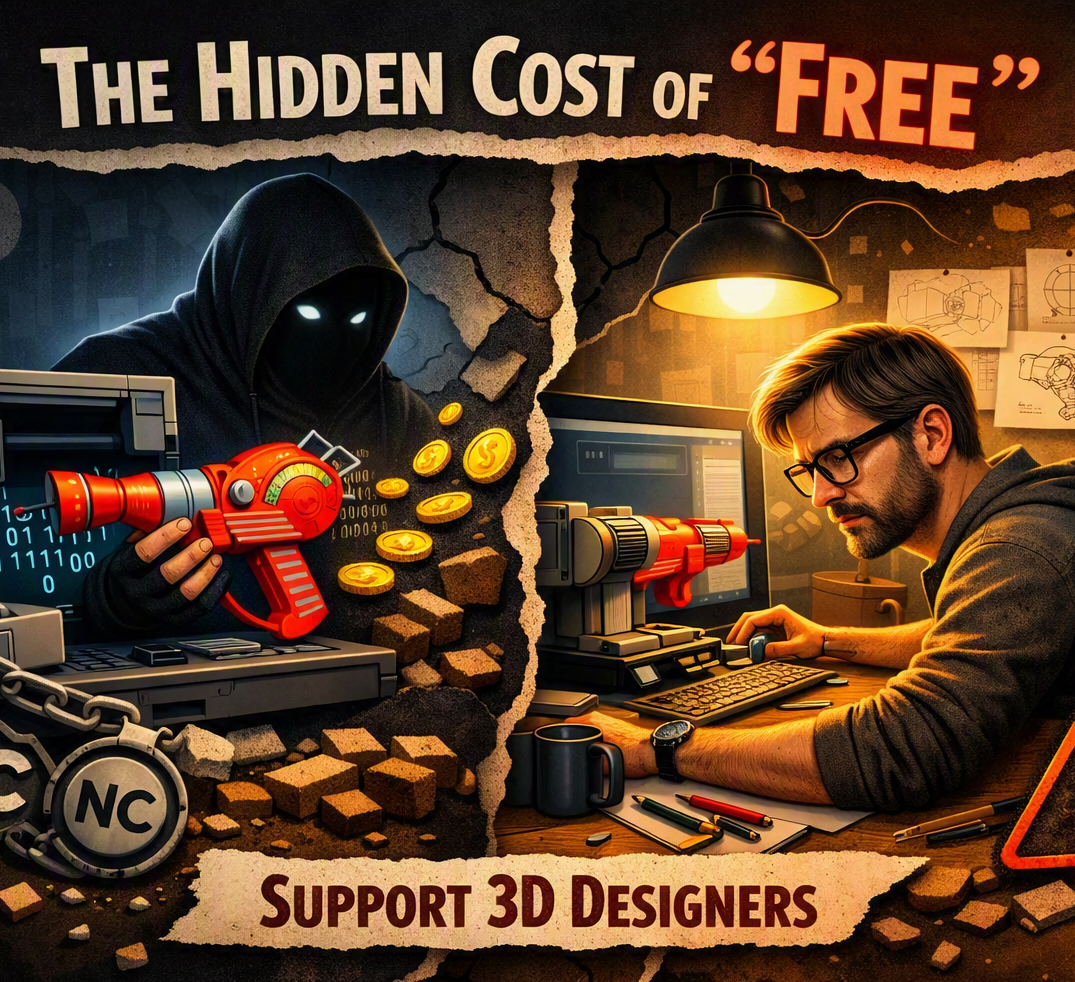
If you love 3D printing, support the people who make it possible - not the thieves, not the resizers, not the AMS recolourers and not the people who claim ownership of work they didn’t create. Support the designers. Support the craft. Support the future of 3D printing. Because the hidden cost of “free” is that one day, the designers stop creating and the community loses everything.
In a world where “free” has become the default expectation, not all 3D model platforms are created equal. Some are built on respect for designers, proper licensing and active moderation. Others are built on volume, popularity and a culture where stolen work spreads faster than the original creator can keep up.
If you’re a designer - or someone who genuinely wants to support designers - choosing the right platform matters more than most people realise.
MyMiniFactory remains one of the most reputable platforms for designers. It has strict licensing options, a clear non‑commercial framework and a moderation team that actually responds when work is stolen. Designers can set their own terms, control their distribution, and choose whether their models are free, paid, or remixable. It’s not perfect but it’s one of the few places where designers still have meaningful control over their IP but sadly they are also expected to pay a monthly subscription to upload their own designs as well as pay a percentage per sale. Myminifactory is still the best platform for selling your designs.
Thangs is one of those platforms nobody realises is powerful until they actually use it properly. It looks like “just another model site,” but under the hood it’s basically a geometry search engine, and that makes it a completely different beast from Cults, MakerWorld, Creality Cloud, etc. When you upload a model (even privately), Thangs creates a geometry fingerprint of your STL. That fingerprint is unique to your design — like DNA with their mesh similarity search, even if a thief, renames your file, changes the pose, scales it, slices it, adds a base, removes a detail, re-exports it, converts it to OBJ or tries to hide it, Thangs still see the match. It’s not a printer company trying to build a community. It’s a geometry‑tech company building a search engine. If someone steals your model and uploads it anywhere Thangs can crawl, the fingerprint matches. Thangs is the best platform for protection.
Cults has thousands of designers and hundreds of genuinely talented ones, yet the platform repeatedly promotes the same small handful - the same “Designer of the Week,” recycled over and over. Visibility isn’t earned through quality; it’s funnelled through a narrow loop.
Cults presents itself as a marketplace that protects creators, but in practice it only removes stolen models when they’re direct reuploads. Mash‑ups, partial copies, and geometry theft slip through constantly. Meanwhile, designers are expected to produce polished videos, logos, photography and branding just to compete, with no guarantee the platform will ever show their work to anyone.
The result is a system where fast uploaders, cliques and hype cycles overshadow originality. Many popular designers gained momentum by piggybacking off others - copying ideas, reworking free models, or leaning on AI while claiming otherwise. Free models are barely promoted anymore which is a good thing, but genuine creators get buried under volume, not quality.
The community mirrors this behaviour: posts with existing likes and comments get pushed, while other creators struggle for any visibility at all. Popularity becomes a contest, not a reflection of skill and integrity gets traded for reach.
We learned this the hard way. Our original Ray Gun 2, created in 2015, was purchased, reuploaded at a lower price and earned over £30,000 for someone else before we discovered it. Cults removed it only after we reported it - no apology, no compensation - and our original was left buried with 47 downloads. Later, similar models uploaded after ours were awarded “Best Design,” proving the badge often reflects marketing, not craftsmanship. Even our own F1 tracks show this: all three were made with identical skill, yet only the first received the badge.
Cults could be a platform that champions originality and protects designers. Instead, it amplifies a small circle, overlooks theft and leaves many creators fighting for visibility in a system that rewards speed, cliques and aesthetics over genuine design work.
Printables is a community-driven platform with a surprisingly strong stance on attribution and licensing. While it has many free models, it also has a culture of respecting designers. Users tend to credit properly and Prusa’s moderation is far more active than most free sites. It’s not perfect but it’s far from the chaos of platforms where theft is normalised. Printables (the Prusa platform) sits in a middle‑ground between “safe like Thangs/MyMiniFactory” and “wild west like MakerWorld/Creality Cloud.” It’s not perfect, but it’s FAR better than the Bambu/Creality and makeronline ecosystems.
MakerWorld is popular - but popularity comes with a cost. It’s fast, flashy and full of activity but it’s also saturated with stolen work, miscredited uploads, resized models passed off as “remixes,” AMS recolours treated as “custom designs,” and users who believe everything should be free. It’s a platform built around printers, not designers and that difference shows. For hobbyists, it’s convenient. For designers, it’s exhausting. Credit where it's due, they are quick to remove stolen models once the designer finds and reports them.
Thingiverse is the oldest example of what happens when a platform stops moderating. It’s a graveyard of abandoned accounts, stolen uploads, broken licensing and models that have been reposted so many times that nobody knows who the original designer was. It’s a cautionary tale - a reminder of what happens when “free” becomes the only currency. We are still waiting for them to remove our FREE ray gun model which was stolen from myminifactory (pics included) and uploaded there -there DMCA online system is broken, it took an email to their legal department to have our design removed.
Social media absolutely trained people to be entitled. It didn’t ask anyone to give away products but it did teach everyone that content should be free, creators should be grateful for attention, clout is currency, likes equal value, popularity equals worth, “exposure” is payment, and everything should be instant, accessible, shareable and remixable. That mindset bled straight into 3D printing but 3D printing isn’t memes and selfies. It’s labour, skill, time, software, testing, iteration and craft. Social media is absolutely not free anymore, most have switched from free to "pay-to-be-seen" unless you already have a large following.
Social media taught people to expect free entertainment. 3D‑print sites twisted that into expecting free labour.
People still haven’t learned. They still think clout matters, likes matter, badges matter, “exposure” matters, uploading daily matters and giving away work matters. That’s why the top STL platforms are drowning in free files: because the culture of entitlement created by social media convinced designers to undervalue themselves and convinced users that creators owe them everything for nothing.
Free files generate massive traffic and traffic generates revenue through sponsorships, affiliate links, printer companies, slicer partnerships and SEO dominance. They’re also now used as a form of advertising by billion dollar companies selling 3D printers and materials because their entire business model depends on designers giving away valuable work for nothing.
The 3D‑printing world has a serious problem: most designers publish their work under clear licences, yet sellers routinely ignore them. Many feel entitled to sell whatever they print simply because they pay for the electricity, filament and the machine, even though designers often ask for as little as £15 a month for commercial rights.
This entitlement means creators who sell their own items can’t safely release their files without being undercut by thieves and large print farms, forcing them to constantly monitor platforms like eBay, Vinted and Etsy, which are notorious for reselling stolen designs. You can’t easily stop small markets or local stalls either. Years of free‑download culture on platforms have created a mindset where many of the public no longer acknowledges the work behind each design or the impact theft has on the creator. It’s a free‑for‑all that devalues the designer, spreads quickly and leaves honest creators fighting to protect the very work they built.
Below I have compiled a list of email addresses to the legal departments or official email addresses if you or someone you know has had their model stolen and reuploaded and the online DMCA takedown is slow or ignored - direct emails have to be taken seriously. Make sure you can provide screenshots and proof of your dated source CAD files or at least links to dated original uploads.