 Change currency
 USD
USD  EUR
EUR
The problem with the 3D printing industry didn’t begin with MakerWorld, Bambu Lab. It started long before that, back when 3D printing was a niche hobby shared by a small group of enthusiasts who uploaded their work for fun, not profit.
Thingiverse launched in October 2008 as a fully free, open‑sharing STL repository created by Zach Smith at NYC Resistor. It was built specifically for the early RepRap and MakerBot DIY crowd and from the very first day it existed, it was completely free. No paywalls, no storefronts, no licensing complexity - just open files, open remixing, and an open invitation for anyone to contribute.
That early culture shaped everything that came after it. Thingiverse wasn’t just a website; it became the foundation of the “everything should be free” mindset that still dominates 3D printing today. It was open‑source at its core, remix‑friendly by design, driven entirely by hobbyists and controlled by a community that valued sharing above all else. Designers uploaded their work without expecting payment and the platform encouraged that behaviour. Over time, it set the tone for the entire industry.
Thingiverse was the first major place where people could publish 3D models without any expectation of compensation and it created the cultural baseline that modern platforms still follow. The idea that 3D models should be free didn’t come from corporations - it started here, with a community that believed openness was more important than sustainability. That mindset has been carried forward ever since.
Many designers were hobbyists who didn’t rely on sales, didn’t need compensation and didn’t see their work as part of a business. They uploaded models freely because they enjoyed sharing and because they could afford to. Over time, that generosity became an expectation. Free became normal. Free became the default. Free became the culture.
That culture is exactly why designers struggle now.
The public doesn’t see the person behind the computer - the hours of CAD work, the engineering, the testing, the talent, the time, the cost. They don’t see the difference between a hobbyist who uploads for fun and a designer who relies on sales to justify the work they put in. They don’t see the value behind a model because they’ve been conditioned not to.
They see a download button. They see “FREE” and they assume that’s how it should be.
Original platforms created that expectation - now many have simply amplified it.
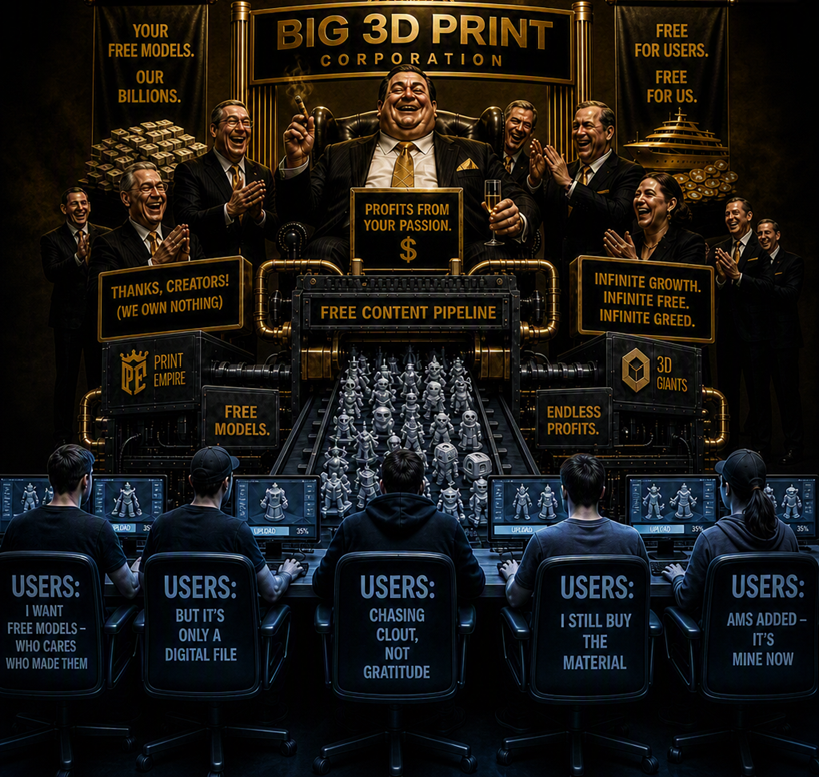
MakerWorld is the clearest new example. It’s a marketplace in name only. In reality, it’s a marketing tool designed to sell printers and filament. Free models cost them nothing, boost their engagement, and drive their sales to record highs. They encourage free because free benefits them. It’s not about community. It’s not about creativity. It’s not about supporting designers. It’s about profit - billions in profit built on the backs of people who are expected to work for nothing.
Yes, MakerWorld has its faults. It actively encourages theft, remixes, and abuse of licensing. It claims to support proper attribution, yet its platform is filled with hashed models passed of as originals, AMS recolours passed off as remixes and remixes uploaded without permission or attribution. Clout chasers thrive because the system rewards volume, not integrity. MakerWorld acts fast on takedowns now, they were sued by Pop Mart International Group, the Chinese toy giant behind the massively popular Labubu character, who filed a copyright infringement lawsuit against Bambu Lab and its subsidiaries — including Shenzhen Maker World Technology because MakerWorld was hosting thousands of user‑uploaded Labubu STL files without permission but the burden still falls on small designers to track their work across multiple platforms and file DMCA reports.
MakerWorld is not the entire root of the problem. It’s just the most visible symptom.
The real issue is the people who expect everything for free. The ones who don’t respect the industry. The ones who don’t value the work behind a model. The ones who believe designers shouldn’t charge because someone else chooses not to. This includes the corporations who profit from this culture. Bambu Lab built their entire ecosystem on free content while being involved in ongoing open‑source licensing disputes. Their platform is built on a foundation of questionable ethics, yet they continue to push a “free-first” mentality because it benefits them financially. They didn’t invent the free culture - they simply exploited it better than anyone else.
The truth is simple: Free isn’t the problem. The Expectation of free is. The Entitlement of free is.
Designers should have the right to choose whether they give their work away or not. They shouldn’t be pressured by hobbyists, platforms, or corporations into undervaluing their own talent. They shouldn’t be forced into a system where originality is punished and exploitation is rewarded.
The 3D printing industry needs to remember that behind every original model - free or paid is a person. Someone with skill, time, and talent. Someone who deserves respect. Someone who deserves the choice.
Until the culture changes, designers will continue to struggle and platforms will continue to profit from a problem they created and have absolutely helped to accelerate.